Rhett


Adam has been diagnosed with an intellectual delay, but he continues to make progress in all aspects of his development and learn new skills. His gross motor skills are developmentally appropriate for his age. He can walk, run, climb, etc. His fine motor skills are slightly delayed. He nests nesting boards according to the principle trial and error. He can build a tower with 10 blocks. He can draw a circle but he can’t draw an emoticon. He can string and sort small figures. He cuts with scissors, forms worms out of playdoh and cuts them. He currently cannot copy shapes and letters according to a pattern. His attention span when working on tasks continues to increase. He has a well-developed visual memory. He will imitate gestures and movements. He can group objects by color and shape, but cannot currently identify colors and shapes by name. He understands what is said to him and can follow one step directions. He has pretend play skills. He can easily navigate in familiar environments. His speech is still developing. He can say some simple words and attempts to communicate using gestures. He is currently attending preschool, and has adjusted well to this environment. He participates in group activities and plays with the other children. He enjoys playing with playdough and participating in music and games. He helps clean up after activities. His self-help skills are developing. He is toilet trained. He is working with specialists to continue to develop his skills.
Vinny has been diagnosed with childhood Autism, but continues to make progress and learn new skills. He can walk, run, climb, throw and kick a ball. He can build a tower with 10 cubes, he strings and sorts small figures. He cuts with scissors and he tries to cut along a drawn line. He has difficulties doing puzzles. He has difficulty concentrating during certain tasks. He is more focused and attentive during activities related to language educational games and modelling with playdoh. He has a strongly pronounced mechanical memory. He has difficulties making the relation between a symbol and a word. He compares objects by color and shape but does not recognize or name them. He understands single-step commands. He participates in role games (he puts a doll to bed and tucks her in). When he sees pictures with objects from everyday life (a broom, glass, spoon) he shows the activities that he performs with them. His speech is delayed (he says very few words), but he attempts to communicate using gestures. He demonstrates attachment to his caregivers and gets along with other children at preschool. He enjoys playing with playdough and educational cards. His self-help skills are developing. He is toilet trained. He is working with specialists to continue to develop his skills.

He is diagnosed with hydrocephalus and has some other medical issues that require in-depth care. The adoption agency has a lot more photos and more information about his needs and video footage. A specific adoption agency also has grant funding in the amount of $2500 available.

Please consider bringing these boys into your family for the New Year. The agency has a lot more photos and information and videos to see these great boys! A specific adoption agency has grant funding in the amount of $2500 available.


A specific agency also has grant funding available in the amount of $2500.


Meet smiling Melly. She had surgical treatment for correction of a meningocele. A ventriculoperitoneal shunt was also implanted to treat hydrocephalus. Unfortunately after surgery Melly’s lower limbs are paralyzed.
Melly moves independently in a wheelchair. She can pull herself up with her hands She enjoys contact with children and adults. She plays with toys, handles them, and can throw them. Melly pronounces various sounds and syllables although she points to make her needs known. She can maintain interest in an activity for 15-20 minutes.

Her caregiver described her as cheerful and happy girl. She has no issues with trust, open to new people and likes to cuddle. She is curious about her surrounding and asks a lot of questions.
She doesn’t always listen what is said to her and has some difficulties with rules and directions. She can be stubborn and needs help with her emotion’s regulation. She started pre-school in September 2024. She loses an interest quickly and has problems to finish her tasks. She enjoys looking at the books, stalking blocks, working with small objects and clay. She likes music and willingly participates in singing activities. Her vocabulary increased and she learns how to ride a scooter. She likes walking and playing outside. She still needs help with her physiological needs. She can dress without help and eats independently.


Violet, 15, and Daniel, 13, are wonderful siblings who share a close bond and bring out the best in each other. Violet is thoughtful, kind, and enjoys writing, dancing, and participating in games. Daniel is lively, sociable, and passionate about sports, with a big dream of becoming a professional wrestler.
Both children are independent, responsible, and emotionally aware, able to manage their behavior and maintain friendships. They enjoy hobbies that keep them active and engaged, from board games to competitive play.
Violet and Daniel are looking for a safe and loving family who will support their dreams, nurture their talents, and provide guidance as they grow. These amazing siblings are ready to bring love, laughter, and warmth to a forever home—together.


Videos are available.

Theodore was born prematurely at 25 weeks; he will need ongoing support from doctors as he continues his development.
He is described as being very cheerful, curious, positive, interested in everything, expresses positive emotions and smiles a lot and responds when spoken to. He listens attentively to adults and can distinguish between a stern and pleasant tone of an adult. Makes single sounds, says words and waves his hand to those leaving. When asked, shows where his nose, eyes and mouth are, claps his hands. He is eager to play with toys for his age and likes toys that make different sounds. The boy is very affectionate and very active. Since March of this year, he has learned to walk independently using a walker. He needs to wear orthopedic footwear at all times. He walks short distances, has an irregular gait, and staggers. He eats a wide variety of food and has no allergies. The child eats on his own, is learning to sit on a potty and is a good sleeper. He can’t hear in one ear as it is undeveloped so he wears a hearing aid and attends checkup appointments for his hearing. He responds when called by name. He enjoys kindergarten and being around other children. He completed a rehabilitation program in 2023 that was very effective and has shown positive changes in his development.


SN: FAS, motor aphasia, celiac disease, hyperopia
This girl is much loved by her caregiver and peers! She lived with her biological family for 2 years and was neglected. After a few years in the foster family, she was placed to the orphanage where she adjusted well. She established a positive relationship with others. She likes to cuddle and is seeking the contact with adults. She is a little bit behind for her age, but she is a smart girl with a lot of potential. She is attending a regular school and her teachers like her.


Please meet this cute boy named Bowie. He was diagnosed with congenital cataracts in both eyes. However he underwent surgical treatment with implantation of intraocular lenses. There is suspected Glaucoma. He is also diagnosed with Children’s cerebral palsy – Quadri pyramidal syndrome. Grand mal seizures with or without petit mal seizures.
Bowie can sit up independently from a lying position. He can stand up by holding on to various objects. He walks independently but it is uncoordinated. The child lags in neuropsychological development. He accepts bodily closeness with pleasure. It is pleasant for him to be held by an adult. The presence of children in his immediate space does not bother him, but he does not show interest in them and does not initiate interaction. He is soothed by riding in a pram or listening to favorite children’s songs. He prefers the environment to be quiet. He becomes nervous and anxious around loud noise. He is entirely dependent on the care of an adult.


He has a support teacher at school who helps him a lot. Wally has difficulty concentrating and the support teacher works with him to be effective in the classroom. He has excellent grades. He is open, creative, intelligent and talkative boy. He interacts better with adults – for example, on the way to school he will approach a person with the dog and ask about something. Because of the problems when other children, he is recommended to adoption of the family without children at home or single mother. The boy dreams about family of his own and he feels very lonely, nobody visit him, and he has no place to go for holidays or vacations.

Please meet Brandon; he has multiple special needs. Sadly Brandon relies totally on the care of others. He sleeps in a room with four other children. The caretaker says he seems to like music and likes the bath. He can make some sounds for speech. He has difficulty feeding and swallowing.
The agency staff member that met Brandon said the following: “According to the caretaker, there is a slight regression, especially in terms of feeding. Unfortunately, I have not been given an opportunity to speak to any of the specialists engaged with the boy and possibly what exactly they are working on. Brandon could have some potential, but it’s very hard to tell. In any case, he needs a lot of love, a lot of attention and a lot of activities.” Could you be the family for Brandon?

Look at the sweet smile on Bella! Bella spends the majority of the time in her bed or in the special stroller that she can be pushed in. She is often fed in the stroller as well. She is fed with a bottle.
Agency staff member said the following: Given the fact that only a rehabilitator is currently working with the child and the staff at the Home only have time to cover her basic needs, it is definitely very difficult to say to what extent the little girl has developmental potential. In my opinion, Bella liked it when she received personal attention such as being spoken to gently, being teased by me or by my showing her different toys. She had been working on a smile during that time. Most of the time, both her arms and legs were in motion, and she even managed to roll over in bed. She needs a lot of love and attention and systematic and purposeful activities with specialists.

Update Nov 2024: Samson was recently moved from a large orphanage to a small group home for children with disabilities. He loves attention and responds with joy with staff interacts with him. He is described as a calm and radiant child.

He was born with low weight and with pathological neonatal period. The child has a
physical development within the lower limit of the norm and mental delay in mild to moderate degree (IQ-41). Phrase speech is not developed, he utters single words; lags behind in the development of habits, skills, emotional and social development.
Uses optical correction due to intermittent heterotropy and astigmatism of the eyes.
The child walks stably and independently. There is delay in the development of the fine motor skills. The emotional status of the child is mostly positive – he is calm and curious. He does not show aggression, he is adaptive. He understands phrasal speech, utters single words, but does not speak. The child is able to play by himself, but he also is looking for the company of other children. Participates in the game process. He feeds himself, his personal hygiene is well-maintained. He controls physiological needs.

A male child, born 2460 g., with a congenital genetic metabolic disease (pyruvate dehydrogenase deficiency), leading to a disorder in the absorption of sugars and carbohydrates. The child is on a strictly individual ketogenic diet (rich in fat and completely excluding carbohydrates). He is fed with special diet milk – Ketocal.
When conducting electroencephalography, epileptic activity was registered, which is why constant anticonvulsant therapy with Trileptal is being carried out. No epi-seizures have been observed after its initiation.
The child lags behind in physical, neuropsychiatric development and motor skills. He needs follow-up by a pediatric endocrinologist and dietician and a pediatric neurologist.
The boy has pronounced axial muscle hypotonia, hypertonia of the limbs. He sits up independently, but still does not stand up in the crib. He is placed in a walker and permanent rehabilitation is carried out. He is calm, does not isolate himself in the children’s group. He shows discontent when he does not like something, but quickly calms down. The child’s sleep is peaceful.
According to a Psychologist’s last Individual Characteristic from November 2024: “ …Over the past months, progress has been reported in the child’s general and fine motor skills. He stands up on his own on a stationary support and steps to the sides, holding on to the stationary support. The child moves by crawling. He can sit alone without support. He spends his waking hours with the other children in the group and he likes it very much, calm and smiling.
Jean-Luc is smiling, radiant, calm. He stands next to the children and does not isolate himself. There is no joint play yet. He cannot initiate contact with the children by himself. He shows dissatisfaction when he does not like something. He enjoys teasing from a familiar adult. During activities, he is involved, but is not active and shows little interest.


Donna’s medical diagnosis includes: Retinopathy of prematurity (ROP) stage 5, post vitrectomy condition bilaterally; secondary glaucoma. Left eye ROP stage4 Nystagmus. Delayed neuro-psychic development. Condition after low birth weight. Self-aggression. Spastic quadriparesis. Iron deficiency anaemia
Dawn was born first. Her medical diagnosis includes: cerebral palsy – spastic quadriparesis. Spastic quadriparesis. Suspected hydrocephalus with normal pressure and hypoplasia of corpus callosum. Grade 1 hypotrophy. Convergent strabismus; hypermetropia. Condition following very low birth weight.
Update July 2024: After their placement into the foster home on May 14, 2024, the girls have adjusted well and made noticeable developmental progress. They show an attachment to the foster mom and follow her instructions. One of the girls can now walk independently and is well oriented in the foster home. The other girl sits with little support. The girls now eat mashed food from a fork or spoon and chew well. They have learned to speak their first meaningful words and are also observed to repeat syllables. While there’s some jealousy between the sisters when it comes to receiving attention, they are emotionally close and hug/hold hands. Videos from July 2024 show one girl as tenacious in exploring her environment and the other as joyful when playing on the floor. The girls attend therapy twice a week and their foster mom is proactive in seeking additional services for them. They like music and singing and enjoy massage from the foster mom. They are thrilled to be playing in the inflatable pool in the backyard. Their foster mom describes them as positive children who will continue to make progress with the right interventions and lots of love.
From a family who met them in 2023
I met these twins when I visited my daughter for trip one in 10/2023. One twin was active and was able to stand holding on and cruise around her crib. She was able to climb right out of her floor crib and back in herself. It was an activity for her and she did it with great ease. She wasn’t trying to escape at any point and would just flip In and out over and over again. She seemed like what you would expect for a toddler. She stopped what she was doing when someone called her name and turned in the direction of their voice. The other sweet twin was always laying down when I saw her. Sometimes in a crib, sometimes in a seat. My daughter asked for “baby” all the time and they would put this twin in her crib with her to lay together. They said she was more “severe”. She definitely seemed more infantile. They were in a really great place where they got plenty of food and were carried around a lot by the staff there. There were 8 kids on that floor in four rooms. The twins shared a room. I believe they are now in a foster situation. They def were pretty easygoing. They had a lot of musical toys which they seemed to like. The active twin kept herself busy a lot but the quiet twin seemed to love cuddling and other kids being around her. I think some of the delays they have may be related to vision impairments. I would imagine they would do well with siblings.

Grayson is a 2 year old boy looking for a family. He struggles with delays in mental and psychomotor development. He is a calm and observant child interested in his surroundings. He is comfortable around other children but doesn’t interact with them, mostly plays independently. He can walk without assistance but unsteadily. It is known that his mother consumed alcohol during her pregnancy, but Grayson has not yet received a FAS diagnosis.

Evalina is looking for a forever family. She is a happy and playful child, with good behavior. She does suffer from a variety of developmental delays, specifically in her motor skills and communication skills. Evalina smiles often and likes to be around people.

Brooklyn has muscular dystrophy and a speech disorder. He has normal mental development. In 2020 he experienced burns over a large portion of his body and had right-sided bronchopneumonia. Therapy: Operative excisional cleaning of the wounds, sterile dressings; intensive treatment of thermal shock; antibiotic therapy. Brooklyn receives additional support in the form of resource teaching. With him a team of specialist work –speech therapist, psychologist, and resource teacher within the limits of the pre-school. The child is for a second year in a row in the same preschool class, because he was delayed from starting first grade because of medical reasons. He likes artistic activities and playing with his peers. He understands and strongly desires to be adopted, even if he does not talk much, his short dialogs are for his future surrounded by his loved ones.
Bailey is a healthy child with age-appropriate physical and neuropsychological development. He has good communication skills, has leadership qualities which sometimes turn bossy, and has a group of friends. He is curious, social and actively interacts with the people around him of different ages. Bailey has the attitude and the mindset for the adoption process with the needed positivity towards providing good living
conditions, including satisfying of the physiological needs, the needs for security, love and belonging, respect and self-affirmation. He understands and strongly desires to be adopted, he often talks about his future, surrounded by his loved ones. The adoption process is so desired and awaited by Bailey. The child is prepared and
ready to have his family, his adoptive parents.


Brent lives in a family environment. He eats pureed food and can drink from a cup. He can crawl very fast on his hands and knees although he does not walk without support. He can pull himself to standing when he desires to do so. He is frightened easily by loud sounds. He does not have a specific activity that he enjoys.
There are no manifestations of aggression, but there are manifestations of auto-aggression, most often expressed as hitting his head against the wall, the bed frame, but not with his hands. Brent loves to go outside and he is taken in a wheelchair to do so.
The in-country staff member made the following personal observations:
Brent is cared for at a basic level. Unfortunately, I don’t get the impression that the child is being worked with systematically and purposefully. There is no connection and exchange of information and guidelines between the Day Care Center and the Family-type Accommodation Center for children with disabilities. Brent needs a loving and caring family environment. He needs a family that would be willing to pay attention to him, play with him, and patiently and purposefully help and teach him.

The agency staff member who met her during March of 2024, says the following: Nany likes music, and it seems to settle her down. She also likes being in the swing. At times she turned to various sounds. She can lift her head slightly while lying on her stomach. Nany is an extremely fragile, sweet and lovable little girl who needs lots of love, attention, understanding, support and lots of cuddles. Given the serious diagnoses, working with additional specialists definitely would ease and help the child’s condition. Nany is in need of a very prepared and supportive family.
Nany’s current adoption agency has grant funding is available for qualifying families.

Ivan has a moderate mental delay with hearing loss in one ear. He also has scoliosis of the spine. He can walk, run, climb and descend stairs alone. Ivan does not speak however he enjoys watching children’s movies. He prefers to play alone. He can feed himself and drinks from a cup. The staff is working on potty training with him.
The agency has a video of Ivan, from Feb 2024.
Update 8/2024
Ivan was born in 2016 and resides in a family-type accommodation center for children. He is a child of Roma origin. The parents consented to full adoption, due to the
inability to care for him. Diagnoses include moderate mental retardation, behavioral disorder, expressive speech disorder with hearing impairment – unilateral conductive hearing loss in one ear. Normal hearing with the other. Scoliosis. He has normal physical development for his age and is in good health. He walks independently, with an unsteady gait, goes up and down stairs alone, runs. Fine motor skills are poorly developed – knows how to match elements, string figures on a rope with help. He feeds himself, holds a pencil with his whole palm and scribbles on the paper, does not know how to draw, does not know how to color, does not know colors, does not know how to cut with a knife, does not arrange a constructor and a puzzle.
He rarely responds to his name. Positive emotion is expressed through a smile. When he is cheerful, he laughs loudly. He shows stubbornness and impatience but does not show
aggression or auto-aggression. He has no developed speech. He understands what is being said to him, recognizes the tone. Feelings are expressed through whining, crying, laughing. No expression of interest in anything specific is observed. He watches children’s movies. He loves attention from an adult. Does not play with peers. Eye contact is not complete. He likes to be hugged. He likes strollers, tries to play with them, prefers to hold them in his hand. Chase and kick a ball. Loves light up toys. He likes to spend time outdoors. During the academic year 2024-2025, he will be in 1st grade with an independent form of education.
He has a peaceful sleep. He knows how to feed himself; he knows how to drink from a cup, he does not know how to dress and undress himself, put on and take off his shoes by himself, but he must be asked. He does his physiological needs in the toilet or potty after prompting, he does not use a diaper.

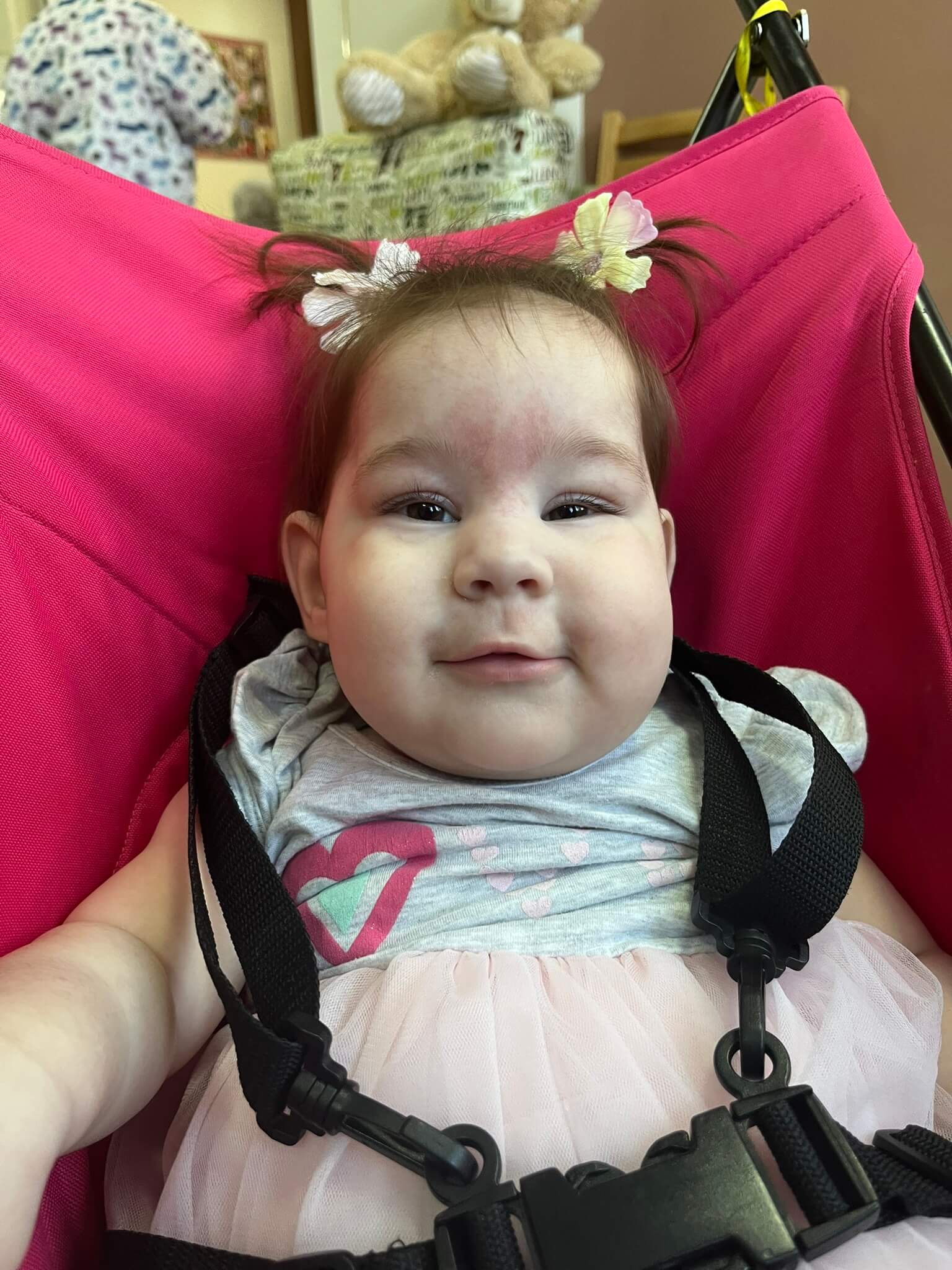
George was born in 2013 and is said to have well developed general and fine motor skills. George is emotionally stable and has good social contact with other children in the school. He does need resource help in school. He has friends and shows respect for adults. He has established habits for independence in dressing, eating and sleeping.
Miles was born in 2012. Miles is diagnosed with deformed feet. He also has some contracture of the fingers in both hands. He has congenital syphilis however he has no clinical symptoms and is not contagious. Miles moves independently but walks on his toes. He also has contractures of his upper and lower limbs. He feels pain with prolonged loading of the musculoskeletal system. However he continues to be energetic and happily runs, jumps and plays with other children. Miles shows affection to adults. He is curious and shows interest an interest in everything. He does need resource help in school. He enjoys being involved in outdoor games with other children.
The adoption agency has very recent videos available of the boys.

Vincent was extremely calm during the whole visit. He sleeps in a small room, together with three other children with disabilities. He sleeps in a crib. He spends most of his time in his bed, being periodically put in a chaise lounge or in a car basket. He cannot sit upright, either independently, as well as with support. His position in the lounger/car seat is semi-recumbent.
Vincent predominantly uses his right hand and his body is almost constantly turned slightly to the right. He can turn from his back to one side and vice versa, he cannot turn on his stomach. When placed on his stomach, he cannot raise his head. Vincent is basically blind, according to the diagnosis and by a specialist, although the staff has doubts because the child often reacts to light. During my visit, when displaying and attempting to stimulate a reaction with a ball of light, no such reaction was observed.
Vincent showed interest in the new toys and especially in the noisy book which he grabbed with his right hand, held for a while and even waved it with his hand. As the teacher shared, he grabs like a crab, with pincers. The ball turned out to be too big for him to hold in one hand. Although the book was kind of prickly, Vincent did not react in any way, not even by pulling away.
A sharp noise does not startle Vincent, this was also evident from the sharp squealing from the side of the ball. He listens when there is music, and can show a slight liveliness/activity. He does not react to his name. He likes to be paid attention to, to be spoken to gently and to be hugged. He does not mind being touched … even from a stranger. Vincent’s entire care must be provided for by an adult. He is fed with a tube, being on 5 feedings per day. He doesn’t get angry or protest when changing or bathing. His sleep is peaceful.
From what I saw Vincent would be much better in a family environment. In the “home”, he mostly spends his time in his bed doing nothing and getting no attention. Every child deserves attention and love and stimulation. I really hope that this sweet boy will find his forever family soon!


Vance was also previously listed as Vinnie.

This precious little one thrives on affection — she has an incredible capacity for love and blossoms with nurturing care that includes endless cuddles, tender personal interaction, and thoughtful understanding. She merits a patient touch and activities tailored just for her, which will provide not only pleasure but also enriching experiences.
During our time together, Elise remained serene and composed, displaying a quiet passivity. My playful attempts to tickle and engage her elicited limited response initially, but as patience persevered, her awareness and interaction gradually emerged.
Elise’s life would be beautifully complimented by a loving family atmosphere, filled with unwavering support and encouragement. A home that teems with warmth and offers plentiful one-on-one interaction, a trove of stimulating activities, and specialist involvement, would cultivate her growth and happiness.
To the kind-hearted families contemplating the rewarding path of adoption: envision a life with Elise, where every day is an opportunity to nourish and celebrate a precious child’s potential, and where love knows no bounds.


Her fine motor skills are delayed. She has difficulty with writing, cutting and grasping objects. She speaks using single words and short phrases. She mispronounces sounds. She has difficulty making choices and decisions and relies on her foster parents for assistance with tasks. She has difficulty with social boundaries and often tries to hug strangers. She shows interest in other children and observes them, but has difficulty with following instructions or following rules with interacting with other children. She requires assistance with dressing. She can feed herself, but has to be monitored to ensure she doesn’t overeat. She is eager to help with household tasks, but struggles to complete them independently. She assists with cleaning the table, sweeping, and similar tasks.