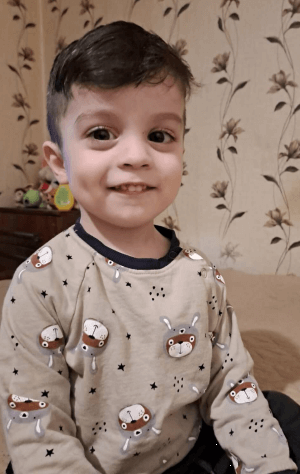
Leena


He demonstrates a global developmental delay affecting physical, cognitive, emotional, and social functioning. Physical development shows a mild delay: he sits independently, stands up on his own, and walks with hand support. Fine and gross motor skills are slightly delayed; muscle tone is adequate, and there are no musculoskeletal disorders.
Neurologically and behaviorally, Dane shows limited social engagement: he does not respond to his name, does not maintain eye contact, does not follow commands, and does not initiate interaction. Play is non-functional and stereotypical (e.g., spinning objects). He exhibits stereotyped behaviors and requires adult guidance for constructive play.
Expressive speech is absent, with only incomprehensible vocalizations and occasional syllables. Cognitive functioning, memory, and intellect are below age level, and higher mental activity cannot be reliably assessed due to age and developmental limitations.
Emotionally, he is generally calm, responds to positive and negative stimuli with a delayed reaction, and shows attachment through hugging familiar caregivers. He rarely expresses needs verbally and may become distressed when objects are taken away.

William loves reading and many outdoor sport activities such as riding bicycle, scooter and playing soccer. He is a bright and adaptable child with a warm spirit, ready to thrive in a nurturing environment.
Due to his country’s matching process, families with a home study for any country can submit to be considered for William.

Twins Nelson and Nellie are six years old. They were born to a teenaged mother who was in protective care herself. Given specific familial concerns that will need to be discussed with interested families, the children were placed into foster care together and eventually were deemed in need of an adoptive family. There is no history of abuse with these children.
Nelson is overall healthy and does not have any medical diagnoses nor does he take any medication. However, while his motor development is age-appropriate, he has a mild language delay. Nelson is able to pay attention and communicate with others, but he has an impairment in his ability to pronounce words and complete sentences with difficulty pronouncing “l” sounds especially. He is receiving speech therapy. His profile indicates a learning delay “considering the developmental scale he is currently in” and recommends stimulation, but there is not a specific diagnosis given. He does not show any difficulty processing sensory information. He is receiving occupational therapy and psychiatric follow-up for a “diagnostic impression of Unspecific Conduct Disorder” but he does not have an official diagnosis. He does not react well when given limits and sometimes throws tantrums when he is not able to do something he wants to do. He does not have any social development concerns, though there are time he prefers to play alone while other times he plays and interacts with his peers.
Nelson is an affectionate child who is able express his emotions to others. He is attached to his foster parents and appropriate seeks their attention and approval when completing tasks. He tends to allow his sister to lead him and to be the dominant sibling in the relationship. It saddens him when he cannot play with her or is separated from her (normal daily temporary reasons, not separated with regard to where they live).
Nelson enjoys playing with cars, dinosaurs and balls. He loves going to the park, playing sports—especially soccer—with his classmates, and he is noted to be a skilled painter.
While Nellie also does not currently have any physical/medical diagnoses, she is being evaluated for Autism Spectrum Disorder. A psychiatric evaluation appointment is pending due to testing showing sufficient criteria for a diagnosis of Autism Spectrum Disorder, but a thorough evaluation is needed to determine a diagnosis. Symptoms noted including persistent language development delay, attention lability, motor restlessness, stereotyped behavior, limited eye contact, and difficulty in understanding directions. A pedagogy evaluation appointment is also scheduled. Nellie displays behavioral concerns, especially with regard to her schoolwork. She is resistant to doing schoolwork (though she is capable to do the work) and to obeying the rules and limits of the classroom. At home, she has resisted doing homework and even has scribbled on her notebooks and thrown them on the floor. At her previous early childhood educational program, she also showed behavioral difficulties and difficulties recognizing authority figures, trouble staying involved in activities and a preference for more open areas of the institution. She cries when she is not allowed to do something she wants to do. However, she is able to play alone or focus on tasks she wants to do such as playing with dolls or dancing.
Nellie’s motor development is age-appropriate. She does not have any difficulty processing sensory information. Like her brother, she is able to communicate but has difficulty with word pronunciation—especially in pronouncing the “l” sound. Socially, she is able to establish relationships with other children and plays with others. Despite her behavioral concerns, she is noted to usually have a good disposition, be cheerful and integrated with her foster family. Her foster family has been given instruction on how to help improve her behavior and there has been progress made.
Nellie is strongly attached to her foster parents and her brother. She is able to give and receive affection with them and sometimes exhibits jealousy when the foster mother shows affection toward other children in the home. She seeks approval from her foster parents and from others with whom she has an emotional bond. Nellie is the more dominant sibling and takes the initiative to ask for things for both herself and her brother.
Nellie finds joy in playing with her dolls and receiving affection from those she is close to. She is an expressive child who engages in caregiving role-play. She likes wearing dresses and having bows in her hair. She enjoys and is good at dancing and singing, and also likes playing with toys, going to the park and watching television.


Bella receives occupational therapy which has helped her be able to scribble with crayons, feed herself, open food containers and snack packages, etc. While she does not speak, she is able to make her needs and wants known through gestures facial expressions, vocalizations, and also through picture cards. She knows a few signs as well such as “thank you.” Due to Bella’s multiple diagnoses, she requires assistance with her daily living activities though she is able to take part in her care.
Bella was born exposed to and addicted to drugs. Following her birth, she was diagnosed with cerebral palsy characterized by dyskinesia and spastic quadriplegia, microcephaly, strabismus, global developmental delay, and severe intellectual disability. In 2017, she was also diagnosed with Autism Spectrum Disorder (ASD).
It is clear that Bella has established a bond with her caregivers and she enjoys their presence. She greets her teachers and plays clapping games with them. She is able to pay attention during lessons and has demonstrated the ability to learn. While she will always need a caregiver, it is believed that being in a loving family will help Bella continue to develop and grow in her abilities. She enjoys playing on a sit-n-spin, swinging or playing on a see-saw. She is drawn to mirrors and toys with lights and/or music.

At the time she came into care, Ariel was referred to physiotherapy, occupational therapy, and speech therapy due to her developmental needs in cognition, speech, social skills and fine motor skills. She was subsequently placed in a special school having been diagnosed with mild intellectual disability in November 2021, and she stayed in that school until June 2023. These measures helped her improve significantly, especially in the area of behavioral tendencies such as being fidgety, having outbursts and being jumpy. In fact, when her foster family moved and she started a new school in June 2023, she adjusted well and her teachers now say she is an above-average student, earning As and Bs in all her grades. While Ariel did have significant improvements in all her developmental areas, she still has some delays in each area. Physically, she can do everything she should, but she is slow when it comes to climbing and needs a handrail to go up and down stairs. She can ride a scooter, but at 11 years old, she still cannot ride a bike. She is able to take care of herself, and can write, draw and do crafts, but she does tend to make mistakes in her Chinese writing. She also tends to eat with a fork or spoon as she does not have the dexterity to use chopsticks effectively. She is also a quiet child who communicates in simple sentences and generally only speaks when spoken to, but she is able to express herself and carry conversations. Ariel does have visual diagnoses of amblyopia, hypermetropia and astigmatism for which she wears glasses and must attend follow-up appointments every six months.
While Ariel was suspected of having autism in 2021 and ADHD in 2023, after attending psychiatric appointments the diagnosis of ADHD was dismissed. The agency is inquiring if she was, in fact, diagnosed with autism as the paperwork is not clear on this matter.
Ariel is a quiet and cheerful girl who is well-attached to her foster family and enjoys going on outings with them. She is helpful in class and enjoys assisting her teacher with various tasks. She is introverted and tends to either play by herself with her special doll or other stuffed toys, or when she does play with others, it is usually with the other foster girl in her home. She enjoys watching videos or playing at the park.
Ariel will benefit from a family who can accept and help her with her mild intellectual disability and social skills challenges. Given her gentle temperament and cheerful nature, she would benefit from a warm, nurturing and stimulating environment where she can continue to receive therapy and receive special education.
UPDATED INFORMATION ON ARIEL!
The agency that sent us her information has received some updated information on Ariel and expects a thorough update January 2026. Please let us know if you are interested in adopting Ariel! (Prior “photo” clipart included for reference to old profile.)
Ariel is a very nurturing and cheerful 11-year-old girl who has been diagnosed with autism and mild intellectual disability as well as vision problems for which she wears glasses and receives follow-up care from ophthalmology. She is healthy overall and is noted to be emotionally stable.
A language barrier won’t be an issue with Ariel–she excels in language, especially English! She can communicate fully in English, including understanding instructions and writing. She follows the directions of her teachers, social workers and foster mother. While her autistic characteristics lead her to rarely initiate conversations and interactions with others, she responds to every interaction and question which makes her easy to bond with. She is emotionally stable and very rarely has tantrums, but when she does, she usually calms down within a few minutes. She is able to care for her own hygiene as well.
Ariel would benefit from a warm, nurturing environment that accommodates her communication challenges while encouraging her to express her opinions more confidently. She longs for family. When her social worker encouraged her to draw a home she likes, she drew a family with parents, a younger sister, cats, and a dog (see attached picture).

Kalin came into care as a baby when his mother brought him to the hospital and it was discovered he was in poor condition. He had a high fever, was malnourished, had a diaper rash and was noted to have overall developmental delay as well as cataracts. His mother was an older teenager and she had not sought any care for the medical condition he had had at birth. Kalin was 5 years, 8 months old at the time of this report from July 2024. Kalin´s current diagnoses are autism, unspecified asthma, congenital cataracts, and overall developmental delay. He takes daily medication. Kalin still wears diapers during the day and night.
Kalin is not formally enrolled in school. He has been diagnosed with autism and unspecified overall developmental delay. He currently goes to physical, occupational, speech, and psychological therapy. The psychiatrist recommended the foster mother take the child to school gradually. He goes to pre-k two days a week and for just a couple of hours. At first, he did not want to stay there but over time, the foster mother states that he is used to going to school and enjoys his time there. He loves toys that make different sounds, and he can play alone for more than 15 minutes.
There are no major concerns regarding Kalin´s gross motor skills, and he is still improving his fine motor skills. Since he is now used to wearing his glasses, this has helped him with his sense of feeling safe to perform different physical activities. He is starting to talk with some difficulties; however, through sounds and facial gestures, it is easy to understand what he wants. He has begun to imitate the sounds of some animals. Kalin is able to identify people´s emotions by looking at their facial expressions. He is able to give and receive affection with those he is familiar with, and he does not get jealous when his caregiver pays attention to other children. He is not shy—whenever he arrives at a new place, he explores his surroundings interacting with adults or kids. At times, Kalin gets anxious when he wants to play with something but needs to wait. Sometimes he gets upset when he is hungry and his food is not ready or he needs to wait for it to cool down. He is afraid of sudden loud noises.
Kalin enjoys playing with toys that make music. The child´s favorite food is spaghetti with chicken or ground beef. He is interested in musical instruments.

Adam has been diagnosed with an intellectual delay, but he continues to make progress in all aspects of his development and learn new skills. His gross motor skills are developmentally appropriate for his age. He can walk, run, climb, etc. His fine motor skills are slightly delayed. He nests nesting boards according to the principle trial and error. He can build a tower with 10 blocks. He can draw a circle but he can’t draw an emoticon. He can string and sort small figures. He cuts with scissors, forms worms out of playdoh and cuts them. He currently cannot copy shapes and letters according to a pattern. His attention span when working on tasks continues to increase. He has a well-developed visual memory. He will imitate gestures and movements. He can group objects by color and shape, but cannot currently identify colors and shapes by name. He understands what is said to him and can follow one step directions. He has pretend play skills. He can easily navigate in familiar environments. His speech is still developing. He can say some simple words and attempts to communicate using gestures. He is currently attending preschool, and has adjusted well to this environment. He participates in group activities and plays with the other children. He enjoys playing with playdough and participating in music and games. He helps clean up after activities. His self-help skills are developing. He is toilet trained. He is working with specialists to continue to develop his skills.
Vinny has been diagnosed with childhood Autism, but continues to make progress and learn new skills. He can walk, run, climb, throw and kick a ball. He can build a tower with 10 cubes, he strings and sorts small figures. He cuts with scissors and he tries to cut along a drawn line. He has difficulties doing puzzles. He has difficulty concentrating during certain tasks. He is more focused and attentive during activities related to language educational games and modelling with playdoh. He has a strongly pronounced mechanical memory. He has difficulties making the relation between a symbol and a word. He compares objects by color and shape but does not recognize or name them. He understands single-step commands. He participates in role games (he puts a doll to bed and tucks her in). When he sees pictures with objects from everyday life (a broom, glass, spoon) he shows the activities that he performs with them. His speech is delayed (he says very few words), but he attempts to communicate using gestures. He demonstrates attachment to his caregivers and gets along with other children at preschool. He enjoys playing with playdough and educational cards. His self-help skills are developing. He is toilet trained. He is working with specialists to continue to develop his skills.

Developmental Evaluation: mild to moderate delays in the gross motor, fine motor-adaptive, language and personal– social skills
The agency has pictures available for seriously inquiring families — Kevin is ADORABLE!
Kevin is an adorable and friendly boy who can confidently play with familiar children the neighborhood. Kevin hums when he hears music or when he is watching television. He enjoys watching nursery rhymes on YouTube. Kevin is diagnosed with autism and with global developmental delays that include language and cognitive impairments. He also has microcephaly and an absent sagittal suture. Kevin has mild to moderate gross motor, fine motor (adaptive), language, and social skills. We’re hoping there is a special family out there for this precious boy! Could that family be yours?

Her caregiver described her as cheerful and happy girl. She has no issues with trust, open to new people and likes to cuddle. She is curious about her surrounding and asks a lot of questions.
She doesn’t always listen what is said to her and has some difficulties with rules and directions. She can be stubborn and needs help with her emotion’s regulation. She started pre-school in September 2024. She loses an interest quickly and has problems to finish her tasks. She enjoys looking at the books, stalking blocks, working with small objects and clay. She likes music and willingly participates in singing activities. Her vocabulary increased and she learns how to ride a scooter. She likes walking and playing outside. She still needs help with her physiological needs. She can dress without help and eats independently.

Nicholas was placed in a foster home when he entered protective care as a newborn due to familial issues. He is now enrolled in pre-k. Due to his complex medical condition, his academic development is limited. Nicholas tries to be independent in some daily activities, such as dressing himself, but for the rest of his care he needs constant supervision, support, and guidance both due to his age, his developmental delay and suspected autism.
Nicholas is a loving and affectionate child toward people he knows and he expresses his love through kisses, hugs, and by clapping. He has a strong need to be near his foster parents and sometimes gets jealous when they are holding another child. He does not like to be around too many people or in places where the noise is too loud. If he is interested in interacting with an adult, he will find a way to call for attention. He communicates through sounds, screams, and some syllables. Sometimes Nicholas gets upset when toys or objects are not organized or placed in the same spot he left them. Nicholas needs an adult to supervise his behavior while he is interacting with other kids, as he needs someone to remind him to behave positively and be patient with others.
Nicholas is constantly moving around and loves to explore his surroundings. He gets easily frustrated when his daily schedule changes. He is very interested in water and on many occasions, he has submerged objects or documents in water. It is reported that his body movements appear to be tough and not well coordinated. He is able to follow simple instructions. He can play with toys and other objects and his fine motor skills are still developing. He spends his time organizing toys and objects by color and size. He is afraid of climbing up and down the stairs. Nicholas still wears diapers but is currently being potty-trained. He goes to bed around 10:00 pm and wakes up at 6:30 am. It is important to give him his medication in the evenings before bedtime. Nicholas loves to listen to music, eat, and explore cell phones.

Videos are available.

Dillon is in the 2nd grade. He is respectful towards his teacher and classmates. It is hard for him to fully understand subjects such as math and language, but improvements have been made in his reading. According to an IQ test, his intelligence is lower than expected for his age. He can stay focused for short periods.
Dillon´s social development has been challenging. During the pandemic he did not interact with other children. He is currently learning to be calm during his interactions and not to become aggressive towards them. Dillon participates in group activities for short periods since he might become aggressive or behave in a bad way. There are days when a situation has triggered Dillon and he then does not want to obey instructions. Dillon gets anxious about loud noises and insects. Sometimes Dillon demands the full attention of his foster mother. While Dillon is very affectionate towards people he is familiar with, he gets anxious and nervous when around unfamiliar people. He gets worried about going out, mainly because he worries about unknown people. Dillon is still learning to manage his impulses and frustrations, and when he is upset he usually hits the walls and screams. It is important to mention that Dillon gets along better with younger children than with his peers. Dillon’s fine psychomotor skills have improved over time. There are no major concerns regarding his gross motor skills; however, due to his diagnosis, he is restless and harms himself sometimes. Dillon is learning to become independent in his daily routines, but he still needs supervision and support. He has good sleep and eating habits. Dillon is still learning to urinary and bowel control, and he often will urinate/defecate outside instead of going to the restroom. He does not take care of his personal belongings and is still learning to have proper hygiene habits.
Going to the park or getting to do errands with his foster mother makes Dillon happy. He likes to play alone, and he has a favorite outfit that he would love to wear every single day.

He has a support teacher at school who helps him a lot. Wally has difficulty concentrating and the support teacher works with him to be effective in the classroom. He has excellent grades. He is open, creative, intelligent and talkative boy. He interacts better with adults – for example, on the way to school he will approach a person with the dog and ask about something. Because of the problems when other children, he is recommended to adoption of the family without children at home or single mother. The boy dreams about family of his own and he feels very lonely, nobody visit him, and he has no place to go for holidays or vacations.

Pah is a lovely little 4-year-old boy in need of a permanent home. He has been with his foster family since he a little baby. He is bonded to his foster family as well as another foster child in the home who is 3 months younger than him.
Pah currently is in good normal health. However, when Pah was 22 days old he showed peripheral pulmonary artery stenosis, small patent foramen ovale (PFO), and secundum atrial septic defect 1.5 mm. On the follow-up echocardiogram in April 2022, the results showed normal heart anatomy and function. As of his August 2024 child checkup, his hearing and vision were reported to be normal. While Pah’s physical health remains good, he has been diagnosed with Autism Spectrum Disorder (ASD) in August 2023, for which he attends Child and Adolescent Psychiatry therapy. During the same evaluation, he was assessed to have a mild delay in gross motor skills as well as a mild delay in oral language. He had been previously diagnosed in 2022 with Borderline Developmental Delay. As observed, he can speak clearly, except that he may mispronounce some words. He is able to hold conversations with adults and express his needs and feelings in sentences. He can also follow instructions. Pah receives speech therapy about 2 times per month, and physiotherapy and occupational therapy 3-4 times per year at school. Pah can walk and run confidently. He can jump forward 12inches with both feet, stand on one leg, walk upstairs and downstairs with alternative feet by holding onto the handrail, throw and catch a ball, and kick a ball forward 5 feet away. He can also climb up the rope net. In terms of fine motor skills, Pah can build a tower of 9 blocks, remove bottle caps, hold a pen to draw, turn pages one by one, and thread beads.
Pah is described as a happy, outgoing but also stubborn child who has shown improvements in his emotional expression. He has become more accepting of reasoning as he gets older. Due to his ASD features, Pah has a set way of doing things. He also tends to cry easily over trivial things such as when he cannot find a toy or complete a task on his own. Pah shares a normal relationship with the other foster child in the home. They have typical sibling-like rivalries and will sometimes fight over toys. He shares a close relationship with the foster mother and accepts her guidance and follows her instructions. Overall, Pah is generally an easy child to take care of. He is well-behaved and manageable most of the time except that he tends to cry easily and can also be quite stubborn at times.
Pah performs well in his self-care tasks. Being able to drink from a cup and a straw, he can feed himself with spoon and a fork. He can wash and dry his hands with a towel; put on and take off his clothes, shoes and socks; brush his teeth and wash his face. He has finished toilet training and does not need to wear diapers. He can go to the toilet by himself. He only needs assistance in bathing, washing his hair and cleaning after a bowel movement.
Pah is attending pre-kindergarten at a nursery school. As described by the teacher, Pah has some close friends at school and enjoys a satisfactory relationship with his teachers. He can follow school rules and routines. Being attentive in class, he enjoys participating indifferent activities. As described, Pah is sometimes sensitive to the teacher’s reminders and sometimes is emotional about this. Pah knows lots of colors, shapes, fruits, animals, food and body parts. He also knows some concepts such as “big-small,” “up-down,” etc. He can recite the numbers from 1 to 50 and recognize some letters and numbers. He can tell others his name and age.
Families with a home study prepared for any international country can submit for consideration of Pah. The agency program specialist can explain the child/family matching process in his country.

Anna is known for being a happy girl. Anna is not enrolled in school as it has been difficult to find an Institution that can work with her diagnosis and special needs. However, when she was enrolled in school, it was noted that she behaved positively and recognized authority figures. Anna loves to give and receive affection, and she does not get jealous when her foster mother pays attention to other children. Her closest bond is with the 12-year-old daughter of her foster mother. She needs support and supervision to fulfill her daily routines. Anna has a good sleep and eating patterns; however, she very occasionally wets the bed. Anna sometimes throws objects to the floor when she feels frustrated. She can follow simple instructions. Due to her diagnosis, it is hard for her to stay focused on one specific task.
Anna can keep her balance and walk, and she tries to jump but is not fully able to do it. She can run slowly and up the stairs if an adult holds her hand. Her fine motor skills are still developing. Anna is not able to hold scissors, but she can grab pencils and color. She needs help with dressing and hygiene. For the most part, Anna communicates through signs and very short words; it is not hard to understand what she wants. She goes to speech therapy. Anna recognizes familiar faces, and she does not get shy when meeting new people. She can play with younger children or with peers, but she gets upset when other children take her belongings. She recognizes her foster mother as an authority figure. She likes dogs as long as they are away from her, and she gets nervous when pets are near her.
Being told she looks pretty or that she is beautiful makes Anna happy. She loves to have her hair done in pretty styles and enjoys wearing new clothes. She likes to watch children’s movies and videos of people doing exercises. She is very good at swimming. Anna´s favorite foods are spaghetti and chicken with rice. She loves to listen to music and do puzzles.

Mia is a cheerful and smiley girl. She has been diagnosed with spastic diplegia, severe mental grade intellectual disability and Autism Spectrum Disorder (ASD) with no current medication needed. She is currently taking sleeping and vitamin supplements. Mia has divergent squint, hypertropia and astigmatism. She is recommended to wear glasses but she shows resistance as she does not like anything to be put on her face or head. Nevertheless, her vision seems not to be affected significantly during classes. Mia was assessed to have severe gross motor delay with dystonia but her walking was commented to become more stable.
Mia is currently attending a special school children with severe intellectual disability and multiple disabilities. She has made steady progress in her development and shown an interest in interacting with adults and peers. She is well loved by her school teachers and caregivers and is one of the brightest students in her special school. She enjoys listening to children’s songs, playing with spinning and musical toys, watching cartoons, playing with the swing during leisure time. Regarding her self-care skills, Mia needs assistance in teeth brushing and washing up and she does not like these tasks. She wears diapers all day long. She receives regular potty training and can urinate on the potty occasionally. She needs assistance in dressing but is able to take off her clothes, shoes and AFOs. She is also learning to put on her shirt when being prompted. She sits in a chair with a safety belt when her caregiver helps her to take a shower.

The adoption agency has additional photos and videos available.

VIDEOS:
https://vimeo.com/maaspecialkids/maa-malcom
https://vimeo.com/maaspecialkids/maa-malcom2
https://vimeo.com/maaspecialkids/maa-malcom3
Password: Adoptmaa
There is a $1,500 agency fee reduction for Malcom’s adoption. Additional agency fee reductions may be available for Malcom’s adoption based on the adoptive family’s circumstances.

Christopher now has a $500 agency fee reduction for his adoption; Additional agency fee reductions may be available based on the adoptive family’ circumstances!

SN: Moderate intellectual disability, Asperger’s syndrome, sensory hypersensitivity
Maeve is a six year old girl with moderate intellectual disability and Asperger’s syndrome. She attends a kindergarten where she receives therapy for movement, speech, and autism. She had disorders in speech, balance, and coordination. She gets anxious when on unstable ground. She has been making tremendous improvement lately. Maeve struggles with sensory hypersensitivity. She is capable of building relationships with her peers and caregivers.
Despite being able to communicate verbally, her speech used to be unclear, but lately it has improved tremendously. Recently, she has become more and more independent. Maeve stands out from the rest of the children at the orphanage.


Walt has been diagnosed with autism and developmental delays. He is nonverbal, does not engage with peers, and prefers to play with rotating, round objects. Walt does not show aggression and expresses warmth toward others on his own initiative. He likes to receive hugs from his foster parent.

Update 2024: Polly now displays some self injurious behaviors. They have seen improvements with the addition of multiple medications, but her behaviors can decline as the meds begin to wear off each day and before an additional dose can be given.

Janet’s favorite activities include crafts, drawing, playing house, and outdoors activites such as basketball and riding her bicycle! Those who know Janet describe her as smart and straightforward. She will openly expresses her own thoughts and is strong-willed. Her caregivers say she does well in one-on-one interactions, and is making progress with peer social interactions.
Janet is going through the process of neurodevelopmental assessments for autism spectrum disorder, Tourette’s, and ADHD. She attends special education classes at her local elementary school and attends the afterschool program. She is an eager learner and enjoys going to school. Janet stated her favorite subjects are Mandarin, Life Curriculum, drawing and PE. Janet has 5 good friends at school, and they LOVE playing hide and seek at recess together!
Janet needs someone who is patient and can give her encouragement and clear boundaries. I