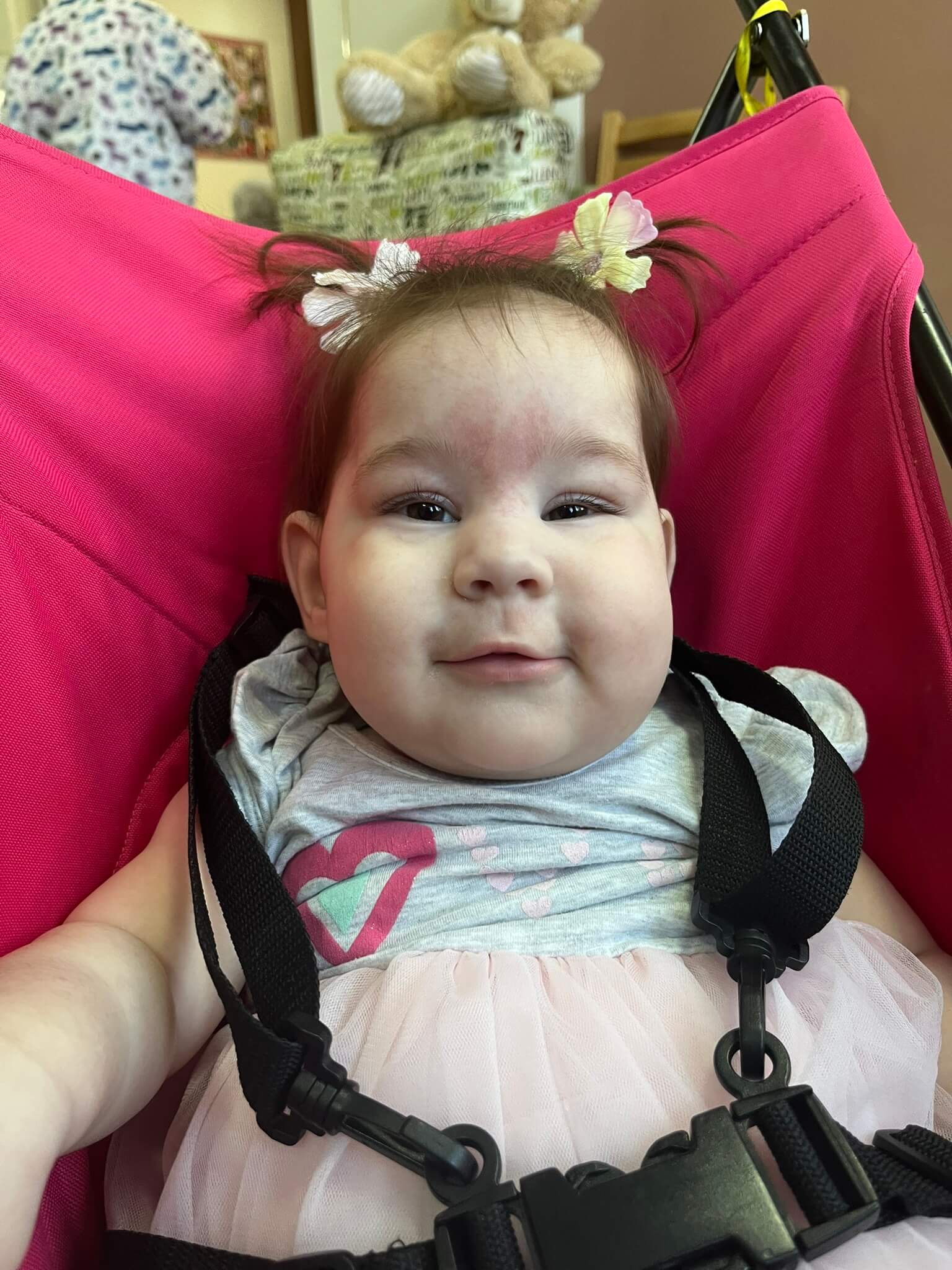
Amelia and Scarlett have been diagnosed with Sickle Cell Disease, which is currently managed with daily medication.

Amelia and Scarlett have been diagnosed with Sickle Cell Disease, which is currently managed with daily medication.

Lucia and Charles are a very bonded Afro-Latin brother and sister sibling set who live together in the same foster home. They came into care when they were 8 and 2 years old respectively. Before coming into care, one of her older brothers often fulfilled a parental role with them but was abusive in this role. When they first came into care and for a while after, Lucia took the position of maternal figure to Charles and was opposing to the foster mothers which led to changes in foster homes. Over time, however, she settled in and started allowing the foster mother to take over the maternal role. They are doing well at their current foster home.
Lucia
Lucia, 15, is currently in the 8th grade where she participates in extracurricular activities, including soccer. She has improved in taking responsibility for her schoolwork over years past and has improved in family and interpersonal relationships. Though Lucia will complete her schoolwork, she is not overly interested in on academic subject over the other. However, she is interested in pursuing studies in beauty related fields such as cosmetology or being a beautician. She also likes to cook and is constantly trying to learn and perfect new skills. Lucia is overall healthy, but will need to continue mental health services to help her work through her past trauma and to transition to a new family.
While Lucia tends to be an independent young lady, she seeks the approval of the adults she trusts to feel safe and confident. Her ability to control her emotions and anxiety has increased and she is learning ways of coping with her anxiety in productive ways. Due to past trauma, Lucia has exhibited a high need for control which contributed to her anxiety, but she has been learning to let go of some control and to allow herself to be in the role she should be in at her age and stage in life. Sadly, it is known that Lucia has been the victim of sexual abuse from at least two perpetrators—one prior to coming into care and one while in care. She self-reported these instances and has received psychological services to help her work through them. Lucia has come to realize that these instances were not her fault and is able to recognize that these instances do not define her. She has not sexually acted out toward others and has not participated in any self-harming behaviors.
As Lucia has continued to work through her past, she is evolving into a responsible and self-aware young lady. Lucia enjoys anything related to makeup and beauty as well as preparing special meals and desserts. When Lucia is happy, it is clearly seen in her face and continence—she literally often jumps for joy.
Charles
Charles, 9, is in the third grade at his new school after the siblings were moved to a new foster home. However, he is supposed to be in the second grade with an individual education plan that had not yet been implemented at the new school as of the time of the report. As a result, his academic performance has been poor this year, but they were supposed to re-implement his plan. Charles has a specialized plan due to a diagnosis of mild mental retardation (F708). Overall, Charles is a very collaborative child with a high sense of belonging who enjoys interactions with his peers. He is motivated by being included in activities and also by being recognized for acts of service. He is able to care for himself independently in an age-appropriate manner.
Charles’ motor skills are age-appropriate, but he does receive occupational therapy and speech therapy. On his IQ testing, he scored 68, but there is a high probability that the score actually falls in the 63-77 range due to some discrepancy between composite indices. More information is available in the child study and available documents. In addition to the diagnosis of mild mental retardation, he was diagnosed in January 2025 with conduct disorder not otherwise specified (F919) and disturbance of activity and attention (F900). He takes daily medication. Charles also wears glasses and had a diagnosis in April 2025 of blepharitis (H010) which is receiving care from the optometrist for.
The change of foster homes has been difficult for Charles, though it was necessary for the protection of the children. Coupled with the change in caregivers and environment is the expected changes in Lucia as she is now older and wants to live the more autonomous life of a teenager that is not filled with being his caregiver as was previously her role. These changes have left Charles feeling lonely and confused. These emotions have affected his behavior, and he sometimes has tantrums or becomes upset easily. It is important to note that Charles has no history of known sexual abuse but was subject as a toddler to the domestic abuse and control from his older brother when he and Lucia were in their birth family.
Charles enjoys going outside, playing football and soccer, going to the park and watching movies. He also enjoys building with blocks.

Arlen and his four siblings came into care in 2022 due to being victims of multiple types of abuse in their family. Their parents were known to be drug users with emotional instability and aggressive behaviors between them. They were also verbally abusive toward the police and other authorities. Arlen is being placed for adoption as a single child.
As Arlen was never enrolled in school until he was taken into protective custody, he is in the first grade. He is familiar with some letters and numbers but cannot read or do simple arithmetic problems. He truly enjoys art class since he has great skills for doing crafts. He seeks adult validation in every activity he participates in. However, while he recognizes authority figures, he is defiant toward them and only obeys with some difficulty. Arlen usually gets along well with peers and adults; however, when he gets mad or frustrated, he begins to behave in a bad and aggressive way. He lies whenever he wants to avoid his responsibilities. He gets upset when he cannot do what he wants. His cognitive development is affected. Arlen has been diagnosed with ADHD, mild cognitive developmental delay, focalized epilepsy, and oppositional defiant disorder. He goes to occupational and psychiatric therapy, and also takes daily medication. There are no concerns regarding his motor and language development.
As mentioned, Arlen and his siblings were subjected to multiple types of abuse. It has been reported by his teachers that in addition to being aggressive toward other children in the class. Though Arlen can verbally express his feelings and emotions, he has a hard time managing them. He gets easily frustrated and has trouble finishing any given task. He is afraid of the dark and of being alone. Arlen gets anxious when he consumes sugary foods, and he also gets anxious when an outing is going to happen soon. He goes to bed around 8 pm but takes a long time to fall asleep.
Even though Arlen has been known to be aggressive toward others, his child study also reports he usually gets along with adults, peers, younger children and animals. Arlen is not shy when meeting people; it is easy for him to take the initiative to start a conversation with anybody. He likes to take the lead in any game. Arlen can be affectionate toward those he knows and is comfortable with. He likes to maintain good hygiene habits and takes care of his personal belongings.
Arlen is very active during the day. He loves to go to the park and to play soccer with friends. Arlen is interested in any outdoor recreational activity; he loves to do physical exercise. He has stated that he is good at swimming. Arlen has stated that he would love to get married and have kids. He does not want to go to college but would like to work handling heavy machines. He is open to being adopted by any type of family.

At the time she came into care, Ariel was referred to physiotherapy, occupational therapy, and speech therapy due to her developmental needs in cognition, speech, social skills and fine motor skills. She was subsequently placed in a special school having been diagnosed with mild intellectual disability in November 2021, and she stayed in that school until June 2023. These measures helped her improve significantly, especially in the area of behavioral tendencies such as being fidgety, having outbursts and being jumpy. In fact, when her foster family moved and she started a new school in June 2023, she adjusted well and her teachers now say she is an above-average student, earning As and Bs in all her grades. While Ariel did have significant improvements in all her developmental areas, she still has some delays in each area. Physically, she can do everything she should, but she is slow when it comes to climbing and needs a handrail to go up and down stairs. She can ride a scooter, but at 11 years old, she still cannot ride a bike. She is able to take care of herself, and can write, draw and do crafts, but she does tend to make mistakes in her Chinese writing. She also tends to eat with a fork or spoon as she does not have the dexterity to use chopsticks effectively. She is also a quiet child who communicates in simple sentences and generally only speaks when spoken to, but she is able to express herself and carry conversations. Ariel does have visual diagnoses of amblyopia, hypermetropia and astigmatism for which she wears glasses and must attend follow-up appointments every six months.
While Ariel was suspected of having autism in 2021 and ADHD in 2023, after attending psychiatric appointments the diagnosis of ADHD was dismissed. The agency is inquiring if she was, in fact, diagnosed with autism as the paperwork is not clear on this matter.
Ariel is a quiet and cheerful girl who is well-attached to her foster family and enjoys going on outings with them. She is helpful in class and enjoys assisting her teacher with various tasks. She is introverted and tends to either play by herself with her special doll or other stuffed toys, or when she does play with others, it is usually with the other foster girl in her home. She enjoys watching videos or playing at the park.
Ariel will benefit from a family who can accept and help her with her mild intellectual disability and social skills challenges. Given her gentle temperament and cheerful nature, she would benefit from a warm, nurturing and stimulating environment where she can continue to receive therapy and receive special education.
UPDATED INFORMATION ON ARIEL!
The agency that sent us her information has received some updated information on Ariel and expects a thorough update January 2026. Please let us know if you are interested in adopting Ariel! (Prior “photo” clipart included for reference to old profile.)
Ariel is a very nurturing and cheerful 11-year-old girl who has been diagnosed with autism and mild intellectual disability as well as vision problems for which she wears glasses and receives follow-up care from ophthalmology. She is healthy overall and is noted to be emotionally stable.
A language barrier won’t be an issue with Ariel–she excels in language, especially English! She can communicate fully in English, including understanding instructions and writing. She follows the directions of her teachers, social workers and foster mother. While her autistic characteristics lead her to rarely initiate conversations and interactions with others, she responds to every interaction and question which makes her easy to bond with. She is emotionally stable and very rarely has tantrums, but when she does, she usually calms down within a few minutes. She is able to care for her own hygiene as well.
Ariel would benefit from a warm, nurturing environment that accommodates her communication challenges while encouraging her to express her opinions more confidently. She longs for family. When her social worker encouraged her to draw a home she likes, she drew a family with parents, a younger sister, cats, and a dog (see attached picture).


Kalin came into care as a baby when his mother brought him to the hospital and it was discovered he was in poor condition. He had a high fever, was malnourished, had a diaper rash and was noted to have overall developmental delay as well as cataracts. His mother was an older teenager and she had not sought any care for the medical condition he had had at birth. Kalin was 5 years, 8 months old at the time of this report from July 2024. Kalin´s current diagnoses are autism, unspecified asthma, congenital cataracts, and overall developmental delay. He takes daily medication. Kalin still wears diapers during the day and night.
Kalin is not formally enrolled in school. He has been diagnosed with autism and unspecified overall developmental delay. He currently goes to physical, occupational, speech, and psychological therapy. The psychiatrist recommended the foster mother take the child to school gradually. He goes to pre-k two days a week and for just a couple of hours. At first, he did not want to stay there but over time, the foster mother states that he is used to going to school and enjoys his time there. He loves toys that make different sounds, and he can play alone for more than 15 minutes.
There are no major concerns regarding Kalin´s gross motor skills, and he is still improving his fine motor skills. Since he is now used to wearing his glasses, this has helped him with his sense of feeling safe to perform different physical activities. He is starting to talk with some difficulties; however, through sounds and facial gestures, it is easy to understand what he wants. He has begun to imitate the sounds of some animals. Kalin is able to identify people´s emotions by looking at their facial expressions. He is able to give and receive affection with those he is familiar with, and he does not get jealous when his caregiver pays attention to other children. He is not shy—whenever he arrives at a new place, he explores his surroundings interacting with adults or kids. At times, Kalin gets anxious when he wants to play with something but needs to wait. Sometimes he gets upset when he is hungry and his food is not ready or he needs to wait for it to cool down. He is afraid of sudden loud noises.
Kalin enjoys playing with toys that make music. The child´s favorite food is spaghetti with chicken or ground beef. He is interested in musical instruments.

The agency has several videos available, too!


VIDEO:
https://vimeo.com/manage/videos/1065191610
Password: Adoptmaa
Agency fee reductions may be available based on the adoptive family’s circumstances (with a specific adoption agency).

The child has severe lag in physical and neuropsychiatric development. Severe mental deficiency. Needs systematic motor rehabilitation, classes with a speech therapist, psychologist and typhlopedagogue. Weak rehabilitation potential. Followed by a pediatric neurologist and ophthalmologist.
The child can turn from back to stomach and back. Does not crawl, does not sit independently, does not have a four-legged stand. Does not stand up, holding on to a support. Holds a toy placed in the hand for a short time. Lacks a pincer grip. The average mental age of the child corresponds to 3-5 months. The child is mostly calm with accompanying episodes of irritability, expressed through crying. Quickly calms down by the presence and attention of an adult. There are no indications of aggressive behavior or manifestations. Does not utter words, syllables and sound imitations. Does not turn when called by name. Does not initiate contact with other children. The child is completely dependent on the care of an adult. Takes food from an adult with a spoon (less often from a bottle). Falls asleep independently.
There is evidence of a brother with an autoimmune disease – Alopecia areata.

Lily (6) is also described as friendly and one who likes to help others. She has delays in her fine motor skills, though improving, and her speech development. She is receiving therapy for both. Lily is a hyperactive child who has recently started taking medication and it seems to be helping, especially with her night movements which have included head banging which has significantly decreased. She lives to sing and dance as well as draw.
Pia (5) is described as a friendly, kind-hearted and playful child who expresses her emotions readily. However, while she shares her emotions readily, sometimes she has difficulty controlling her emotions and is in therapy to assist her with this—yet it is reported that temper tantrums are not frequent and she is able to regain emotional regulation quickly. She has age appropriate gross and fine motor skills as well as speech development. She loves to sing and dance.
The girls are listed for adoption together. Their older sister, Winnie, is also available for adoption (but separately). The agency is hoping to find two families, so the girls can maintain contact.

Winnie has two sisters who are also available for adoption, but separately from Winnie. The agency is hoping to find two families, so the girls can stay in touch.

Sally and Ria live in a foster home.
Sally is in the fifth grade where she is an average student. She likes to go to school, and she is known for being helpful and kind. However, it is difficult for her to fully understand the different academic contents which often leads her to get easily frustrated and give up. It is important to mention that while living with her biological family, there were many times when she was not enrolled in school which likely contributes to her difficulties. While her favorite subject is language, her language and cognitive development are delayed. Sally has trouble reading and making complete thoughts. She also has trouble with math. She easily forgets new concepts. It has been observed that the child has difficulty following complex instructions. For the most part, Sally manages her frustrations and impulses, but there are moments where she gets overwhelmed with a task or homework. It is hard for her to stay quiet in one place as she is curious of her surroundings and active. She recognizes authority figures and is respectful towards them.
There are no concerns regarding her motor development. Socially, she interacts positively with adults, peers, younger children, and animals. She is able to give and receive affection, and sometimes she gets jealous when her foster mother pays attention to the other children. Sally gets anxious when she finds herself in a new environment and with unknown people. She is shy when meeting new people and often needs a mediator to help her interact with others. However, once she knows a new child, she enjoys interacting with her peers. She is able to verbally express her feelings and emotions. It is upsetting to her when she is scolded for misbehaving. She also worries that she may be separated from her sister. Sally is still learning to take care of her belongings and requires supervision from her foster mother to keep all her things organized and in a good state. Sally also requires supervision with her hygiene. Sally goes to occupational therapy and has follow-up visits with the psychiatrist.
Sally enjoys playing pretend, especially with her teacher or her sister. She is interested in playing soccer but due to her nutritional state, she had limitations to do sports. Her favorite colors are pink and purple. Sally would like to become a doctor to help anybody in need. She has also stated her desire to have a mom, a dad and another sibling.
Ria is in the third grade. Her academic performance is lower than expected so she receives extra support after school. She loves anything art-related, and her least favorite subject is math. She recognizes authority figures, follows rules and is usually respectful toward adults. Ria gets easily distracted and requires supervision to fulfill her tasks. It is hard for her to stay quiet in one place, and she needs to be reminded of what is expected of her in different locations. Ria had an IQ test, and the results showed a delay in her chronological age. She has trouble memorizing things, is hyperactive and gets easily distracted.
There are no concerns regarding her motor development. Her expressive and comprehensive language development is delayed. Socially, Ria is shy when meeting people and will wait until somebody takes the initiative to start a conversation. Ria gets anxious whenever she is in an unfamiliar place and surrounded by unknown people, and it upsets her when she is approached by unfamiliar people. Ria interacts positively with adults, peers, younger children, and animals. She seeks to have friends, but sometimes this seeking has caused behavioral problems at school. She does not get jealous when her foster mother pays attention to the other children. Ria used to lie to avoid the consequences of her actions, however this behavior only happens from time to time. Ria is able to verbally express her feelings and emotions, and she manages them at an age-appropriate level. The foster mother needs to constantly remind her to take care of her personal belongings and to improve her hygiene. She gets upset when peers take her belongings without her permission. It is also upsetting to her when her foster mother has to scold her.
Playing with her foster siblings and her sister makes Ria happy. She has great skills in drawing and painting. Ria has stated that she would love to have a mom, dad, and other siblings. She would like to become a doctor, veterinarian, nurse, or teacher.

Due to the extreme hydrocephalus, Malachi is in impaired general condition, with significant lag in psychomotor development – no head control, does not turn around, does not sit or stand. He needs specialized care, monitoring by medical specialists, and daily medical rehabilitation. He is usually in a positive emotional state. He coos frequently and continuously. He reacts animatedly to the speech of an adult. He initiates a desire for physical contact by smiling. The boy is completely dependent on the care of an adult. His sleep is peaceful. He takes food with a pacifier. The agency has videos of him.


Adam has been diagnosed with an intellectual delay, but he continues to make progress in all aspects of his development and learn new skills. His gross motor skills are developmentally appropriate for his age. He can walk, run, climb, etc. His fine motor skills are slightly delayed. He nests nesting boards according to the principle trial and error. He can build a tower with 10 blocks. He can draw a circle but he can’t draw an emoticon. He can string and sort small figures. He cuts with scissors, forms worms out of playdoh and cuts them. He currently cannot copy shapes and letters according to a pattern. His attention span when working on tasks continues to increase. He has a well-developed visual memory. He will imitate gestures and movements. He can group objects by color and shape, but cannot currently identify colors and shapes by name. He understands what is said to him and can follow one step directions. He has pretend play skills. He can easily navigate in familiar environments. His speech is still developing. He can say some simple words and attempts to communicate using gestures. He is currently attending preschool, and has adjusted well to this environment. He participates in group activities and plays with the other children. He enjoys playing with playdough and participating in music and games. He helps clean up after activities. His self-help skills are developing. He is toilet trained. He is working with specialists to continue to develop his skills.
Vinny has been diagnosed with childhood Autism, but continues to make progress and learn new skills. He can walk, run, climb, throw and kick a ball. He can build a tower with 10 cubes, he strings and sorts small figures. He cuts with scissors and he tries to cut along a drawn line. He has difficulties doing puzzles. He has difficulty concentrating during certain tasks. He is more focused and attentive during activities related to language educational games and modelling with playdoh. He has a strongly pronounced mechanical memory. He has difficulties making the relation between a symbol and a word. He compares objects by color and shape but does not recognize or name them. He understands single-step commands. He participates in role games (he puts a doll to bed and tucks her in). When he sees pictures with objects from everyday life (a broom, glass, spoon) he shows the activities that he performs with them. His speech is delayed (he says very few words), but he attempts to communicate using gestures. He demonstrates attachment to his caregivers and gets along with other children at preschool. He enjoys playing with playdough and educational cards. His self-help skills are developing. He is toilet trained. He is working with specialists to continue to develop his skills.

He is diagnosed with hydrocephalus and has some other medical issues that require in-depth care. The adoption agency has a lot more photos and more information about his needs and video footage. A specific adoption agency also has grant funding in the amount of $2500 available.

Please consider bringing these boys into your family for the New Year. The agency has a lot more photos and information and videos to see these great boys! A specific adoption agency has grant funding in the amount of $2500 available.


Developmental Evaluation: mild to moderate delays in the gross motor, fine motor-adaptive, language and personal– social skills
The agency has pictures available for seriously inquiring families — Kevin is ADORABLE!
Kevin is an adorable and friendly boy who can confidently play with familiar children the neighborhood. Kevin hums when he hears music or when he is watching television. He enjoys watching nursery rhymes on YouTube. Kevin is diagnosed with autism and with global developmental delays that include language and cognitive impairments. He also has microcephaly and an absent sagittal suture. Kevin has mild to moderate gross motor, fine motor (adaptive), language, and social skills. We’re hoping there is a special family out there for this precious boy! Could that family be yours?

A specific agency also has grant funding available in the amount of $2500.


Meet smiling Melly. She had surgical treatment for correction of a meningocele. A ventriculoperitoneal shunt was also implanted to treat hydrocephalus. Unfortunately after surgery Melly’s lower limbs are paralyzed.
Melly moves independently in a wheelchair. She can pull herself up with her hands She enjoys contact with children and adults. She plays with toys, handles them, and can throw them. Melly pronounces various sounds and syllables although she points to make her needs known. She can maintain interest in an activity for 15-20 minutes.

Sophie loves people. She can be easily comforted by hugging, gentle stroke, and comforting words. Sophie expresses herself nonverbally. She nods or smiles when she likes something, and pouts or frowns when she does not. She joyously participates in the activities the caregivers and teachers give her such as sunbathing outside and sensory activities. Her caregivers and teachers report that she is easy to care for and manage because of her calm nature and generally stable health condition. She also adjusts to changes quickly and easily.
It is believed Sophie will continue to make progress in reaching her potential within a loving and caring family. Due to the unique child/family matching system in her country, a family with a current home study for any country can submit to be considered to become her family.


Hans was born to a young teenage girl who, tragically, had already given birth to a child at a very young age. Due to her chronological age and emotional immaturity the mother was not able to fully understand her responsibility, and despite the support of her family, the bond between Hans and his mother was not positive. After Protection Services became involved, it was evident that the biological mother and her family were not able to take care of the child due to his special needs, economic struggles and already caring for Hans’s older sibling. He, therefore, came into care at the age of 3 years old. There is no information about the biological father.
Hans is not enrolled in school due to his medical diagnoses. Hans loves to receive affection, and he responds through smiles. He is totally dependent on others to fulfill his daily routines. He communicates through guttural sounds, screams or by crying. Hans cries whenever his diaper is dirty. Hans´s gross and fine motor skills are not developed. The child cannot hold his head up, and he cannot crawl or walk. He has some body movements, and the foster mother has received training on how to stimulate his motor development. He does not like to be held and prefers when people change his body position without holding him for too long. Due to Hans’s medical diagnosis, he has a severe cognitive delay and is not able to interact with other children. Hans receives occupational, physical and speech therapy. Hans takes daily medication.
Hans likes to listen to soft music. He needs a family who can always take care of him due to the severity of his condition.

Everly is an adorable little girl with a bright smile. Everly was born prematurely, and has several special needs. She loves bath time. She also loves affection. Everly is continuing to grow and develop. We hope a loving family sees her while she is so young.
Videos available!

Older brother Rafael (born in 2014), likes being outside and jumping on the trampoline. He loves chicken, rice, and cake. Rafael has developmental delays and is currently attending a special education school.

Update in 2025 states that she no longer has a feeding tube, and is doing really well!
Valeria was previously listed on Reece’s Rainbow as Marisol.

Melissa has a diagnosis of Cornelia de Lange syndrome, which causes developmental delays. She continues to make progress with therapy.
Melissa was previously listed on Reece’s Rainbow as “Lucia.”

Information in this report is from March 2024
Cheyenne, 12, came into care in 2020 when her mother left her with a woman and it became clear that she was not returning. In the child investigation, it was discovered that Cheyenne had been the victim of abuse by both a non-family member when she was young and a minor relative though there is not much information regarding the later situation. Due to being moved around so much and the chaotic environment of the biological family, Cheyenne was not consistently enrolled in school which has affected her cognitive development. Cheyenne is now enrolled in school, and she is in 4th grade where she is respectful, responsible, and motivated at school. In 2023, she was given an IQ test and scored 63, which led to a diagnosis of mild cognitive delay. At the age of 11 when the test was performed, it was estimated that she had the cognitive development and maturation of a 7-year-old. She goes to cognitive therapy to overcome her diagnosis of mild cognitive delay due to the family environment she grew up in.
Cheyenne has adjusted well to her foster family and being in a positive family environment. For example, while she likely did not attend religious services in the past, she enthusiastically attends Catholic services with her foster family and participates in spiritual activities such as praying the rosary with the family. Her foster family has helped her work on her social development, interaction with others, taking responsibility for her actions in a positive way, etc. It is noted that Cheyenne had a habit of lying to avoid negative consequences; however, great improvements were made in this area. While she still gets anxious when confronted about any inappropriate behaviors, Cheyenne is no longer afraid to accept the consequences of her actions. It is upsetting to her when someone lies about her. She is cooperative and strives to be obedient, and she is getting better at managing her emotions, impulses, and frustrations. She gets sad when others positively talk about their biological families, and she just wants to find her forever family. She is afraid of feeling alone.
Cheyenne is very affectionate and sweet. She is friendly and has wonderful skills to be a leader inside and outside her foster home. Cheyenne interacts positively with adults, peers, younger children, and animals. Cheyenne is quiet and feels good when she finishes the tasks assigned to her. She is independent and fulfills her daily routines on her own.
Cheyenne enjoys participating in recreational or playful activities with her peers. She especially likes riding her bicycle and playing soccer. She also likes to draw and dance. Cheyenne loves to eat spaghetti, rice with chicken, and oatmeal, but she does not like to eat broccoli. Cheyenne has stated that she would love to become a Chef to express her love through food.

Dezi lived with his biological parents and older sibling until he was almost four years old. While his parents tried to take care of him, money was always lacking and ultimately, his parents knew they could not meet Dezi’s healthcare needs. In order for him to get all the help he needs and to have a better life, his parents relinquished him to protective care services in July 2022.
Due to the child´s medical diagnosis, he is not enrolled in school. There were two times were Dezi attended a special school, but his needs were much greater than what the teachers could manage. Dezi´s adjustment to a foster home was challenging but his current foster mother has done a great job with him. He has developed a strong bond with his foster mother and regulates his emotions in accordance with what she is doing or how close she is to him. He is now able to give and receive affection, which is a great achievement, and he even sometimes gets jealous when his foster mother pays attention to the other children. Dezi’s language is almost nonexistent, but he says a few words such as “ma.” He communicates mostly through facial gestures and by pointing at things he wants to grab or do. When Dezi gets upset, he cries and has “tantrums,” throws objects, and lays himself on the floor. Dezi is not comfortable being around people he is not familiar with. If he likes somebody, he will usually pull that person by the arm to start a game. Dezi likes to play with other children for short periods, and he is not aggressive towards them. He gets anxious when he is not familiar with an environment. He gets upset when he is not allowed to do something or eat at different moments throughout the day.
Dezi is very active, he changes from one activity to another in short periods, it is very hard for him to focus his attention on one specific thing. There are no concerns regarding his gross motor development, he is still working on his fine motor skills. He needs guidance and support to fulfill his daily routines though there are some activities that he can do on his own, such as eating with no help and dressing up. He sleeps throughout the night without any inconvenience. Dezi does not wear diapers during the day as he can go to the bathroom alone but needs help to clean himself up; he wears diapers during the night. He does not like animals.
Dezi’s favorite show is Paw Patrol. He gets happy when he gets new toys, especially cars even though toys do not usually last a long time because he plays roughly with them. He likes to wear clothes with Superman logos or drawings. Dezi has a good appetite and eats every kind of food. He likes to play with water.

Nicholas was placed in a foster home when he entered protective care as a newborn due to familial issues. He is now enrolled in pre-k. Due to his complex medical condition, his academic development is limited. Nicholas tries to be independent in some daily activities, such as dressing himself, but for the rest of his care he needs constant supervision, support, and guidance both due to his age, his developmental delay and suspected autism.
Nicholas is a loving and affectionate child toward people he knows and he expresses his love through kisses, hugs, and by clapping. He has a strong need to be near his foster parents and sometimes gets jealous when they are holding another child. He does not like to be around too many people or in places where the noise is too loud. If he is interested in interacting with an adult, he will find a way to call for attention. He communicates through sounds, screams, and some syllables. Sometimes Nicholas gets upset when toys or objects are not organized or placed in the same spot he left them. Nicholas needs an adult to supervise his behavior while he is interacting with other kids, as he needs someone to remind him to behave positively and be patient with others.
Nicholas is constantly moving around and loves to explore his surroundings. He gets easily frustrated when his daily schedule changes. He is very interested in water and on many occasions, he has submerged objects or documents in water. It is reported that his body movements appear to be tough and not well coordinated. He is able to follow simple instructions. He can play with toys and other objects and his fine motor skills are still developing. He spends his time organizing toys and objects by color and size. He is afraid of climbing up and down the stairs. Nicholas still wears diapers but is currently being potty-trained. He goes to bed around 10:00 pm and wakes up at 6:30 am. It is important to give him his medication in the evenings before bedtime. Nicholas loves to listen to music, eat, and explore cell phones.

Fera did not attend school until 2021 but has already progressed to the fifth grade! Her academic development has been great. She gets anxious when she has tests at school or when she is asked about her Indigenous community. It bothers her when she is not able to complete homework on her own. Fera recognizes authority figures; she is respectful and obedient toward them, including her teachers. She can stay focused on one specific task and follow simple and complex instructions.
Fera is known to be very responsible. She is an independent girl, who does not require help to fulfill her daily routines; she is a great helper around her foster home. She has good sleep and eating habits. Fera manages her impulses and frustration in accordance with her chronological age. She is usually calm and collected. When situations bother her, she simply moves to a different place and abstains from any interaction. Fera takes good care of her personal belongings and is well organized. She has good hygiene habits.
There are no concerns regarding Fera’s motor, language, cognitive and social development. Fera is currently clinically healthy, she does not take any medication. Due to a tuberculosis episode, she goes from time to time to see the pneumologist. While she is clinically healthy, it is important to realize that all children available for adoption has a history of trauma and likely will need psychological/mental health services once they are home.
Fera is shy by nature—she is quiet and takes her time to feel comfortable and interact with others. She is very selective with her group of friends or people she trusts. She keeps a low profile and does not feel comfortable being the leader of group. She is able to give and receive affection, and she does not get jealous when her foster parents pay attention to the other children. She interacts positively with adults, peers, younger children, and animals. Seeing homeless children or stray animals wandering on the street makes Fera sad. She is also afraid of the dark and deep waters.
Fera enjoys spending time with her friends, especially when she gets to go to the pool or the river with them. She especially likes going to birthday parties she is invited to at times. She also enjoys simple things like going for a walk. Fera is talented at painting. She says would like to become a veterinarian and take a beauty course to learn how to do different hairstyles.


Violet, 15, and Daniel, 13, are wonderful siblings who share a close bond and bring out the best in each other. Violet is thoughtful, kind, and enjoys writing, dancing, and participating in games. Daniel is lively, sociable, and passionate about sports, with a big dream of becoming a professional wrestler.
Both children are independent, responsible, and emotionally aware, able to manage their behavior and maintain friendships. They enjoy hobbies that keep them active and engaged, from board games to competitive play.
Violet and Daniel are looking for a safe and loving family who will support their dreams, nurture their talents, and provide guidance as they grow. These amazing siblings are ready to bring love, laughter, and warmth to a forever home—together.


Videos are available.

When Mell was born, his biological parents tried to take care of him even with his special needs, but they lived in a small town far away from cities and hospitals. At his one month check-up, he was diagnosed with congenital malformation of the spinal cord, hydrocephalus, low weight, fetal growth delay, and respiratory syndrome. At one of his following check-ups, the doctor sent Mell to the hospital due to a high fever and inflammation of the brain. Sadly, though they had tried, his parents recognized that they did not have the means of caring for him in the ways he needed, both due to finances and distance from necessary medical care, and they asked Protective Services to care for him. No other family members were able to provide the care he needed as well. Mell was placed in a foster home and is doing well.
Mell has been receiving various types of therapies which have been valuable in his development. When meeting adults for the first time, he becomes shy, but he recognizes familiar people and loves to interact with them. Mell identifies the emotions on people´s faces and interacts accordingly. He is a very expressive child who shows affection in various ways, and sometimes gets jealous when his foster mother gives affection to the other children. According to the professionals who care for him, Mell has the language development of a 12-month toddler. He communicates through crying and screaming and can say some short words such as “mama” and “papa.” He also imitates animal sounds, such as those of a dog or cat. He responds to simple instructions such “Take this” and “Give me that.” Mell identifies different body parts, plays with Play-Dough, and performs other activities that strengthen his fine motor skills. His movements are spontaneous despite the limitations he has in his lower limbs. Due to his chronological age, Mell requires support, supervision, and guidance to fulfill his daily routines. Mell takes two naps during the day and sleeps throughout the night. He wears diapers all day.
Mell likes to interact with peers or adults and loves to spend time outside. He gets excited when he hears a motorcycle engine as he immediately thinks he is going to go out and gets anxious. He gets upset when his diaper is dirty and when he is not allowed to go out. Mell gets happy with simple things, and he likes to laugh a lot. Mell loves to drink sweet juices. Due to his medical condition, he does not wear shoes but wears very soft socks. He enjoys it when adults help him to kick the ball to play soccer. Mell also likes to play with cars and airplanes.

Lilian is described as happy and communicative girl who is very creative. She interacts positively with adults and other children. She is currently in the fifth grade where she is known to be a good student.
Sonny is a quiet boy though he smiles and babbles to communicate with others. He is a quadriplegic child with cerebral palsy and epilepsy.
The agency can attempt to obtain additional information for interested families.

Information in this report is from March 2023 when Jana was 5. The adoption agency has medical records and pictures for Jana dating back to 2019.
Jana entered care at one year of age due to abandonment and negligence. Within her foster home, it is evident that Jana likes to interact with others. In her own special way, Jana is able to share and receive affection. She communicates with others through body language and eye movements. The foster mother has learned to read her body movements to identify if something is bothering her. Jana responds to stimuli generated through loud voices. Due to her medical diagnoses, she needs constant supervision and guidance to fulfill all her daily routines. Jana´s gross and fine motor development is delayed. Her cognitive development is severely damaged due to her medical diagnoses. She wears diapers all day. Jana spends her days seated in her wheelchair or laying down in her bed when she sleeps. She receives therapy and medication through her gastrostomy.
According to the foster mother, Jana loves to receive massages. She likes when people speak to her in a soft voice. Jana enjoys going outside for short periods.