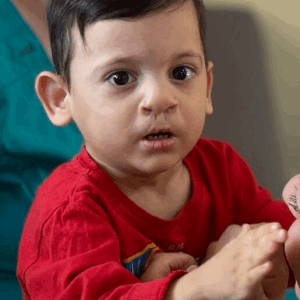
Andrew regularly receives physiotherapy, occupational therapy, and speech therapy. He continues to receive follow-up care in neuropediatrics and orthopedics, including the administration of botulinum toxin due to stiffness in the upper limbs. He has hip dysplasia, currently without pain, and underwent surgery for hip stabilization on September 1, 2025. He also continues to receive care in nutrition, ophthalmology, physical medicine, and rehabilitation.
Andrew has a good relationship with both other children and caregivers. In his interactions, he verbally communicates his needs and interests and is able to express discomfort or displeasure.
Andrew is a communicative and expressive child with a reasonable vocabulary and the ability to construct sentences, including negative and interrogative forms. He repeats and learns new words; however, he needs support to improve articulation and diction. To support this, syllabic division exercises are incorporated during games and storytelling activities. He demonstrates a good understanding of his surroundings and, with individualized adult guidance, is able to focus his attention on tasks and interpret simple content.
In the area of autonomy, although Andrew is dependent on adults for his daily routines, he enjoys being involved and participating in tasks. He helps tidy up toys and materials and eats independently at mealtimes using cutlery. He shows greater ease in using a spoon but is also able to use a knife and fork. He can drink independently from a cup or mug.
It is not expected that Andrew will be able to walk; therefore, he uses an electric wheelchair. He demonstrates good autonomy in operating the joystick with his right hand and maneuvers the chair with ease (e.g., anticipating obstacles, navigating around them, reversing, and turning left or right to avoid collisions with people or objects). He has a clear sense of space. The acquisition of the electric wheelchair has been fundamental in supporting Andrew’s autonomy in locomotion. During the summer, he independently accompanied the group on several outings. Additionally, using the electric wheelchair, he is able to accompany an adult while carrying out small tasks (e.g., going to the supermarket or pharmacy).
Despite difficulties with fine motor skills, Andrew shows persistence and interest in exploring objects, toys, and new materials. He enjoys matching and fitting games, stacking objects, and painting with pencils, markers, or brushes using a gross grasp. With assistance, he participates in collage and tearing activities. In drawing, he currently scribbles and does not yet represent the human figure. He also enjoys handling books and is able to turn pages independently to observe the illustrations.
Andrew transitioned to the public preschool network in the 2025–2026 school year following a request for school postponement. According to information provided by his teacher, Andrew adapted well, integrated into daily routines, and maintained positive interactions with adults and peers. However, the teacher noted that Andrew experiences difficulties handling tools during writing and artistic expression activities and is not yet able to perform a fine pincer grasp. As a result, he shows limited autonomy in completing more structured tasks and may resist finishing them (e.g., giving up or becoming distracted). He will soon be evaluated by the technological resources center for possible allocation of an adapted computer.